

❋
Urethral Strictures
Understanding urethral strictures
What is a urethral stricture?
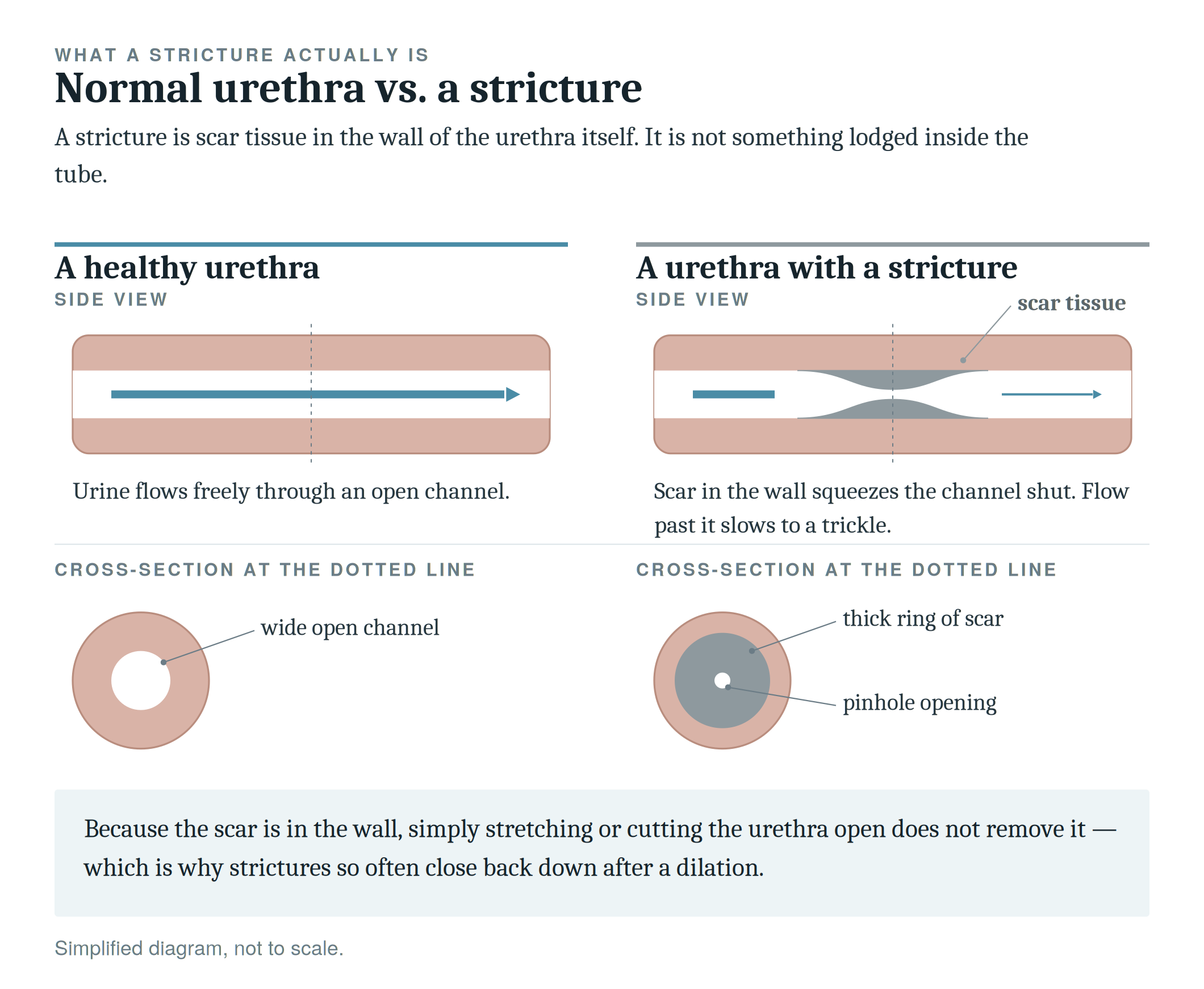
The urethra is the tube that carries urine from your bladder out of your body. A urethral stricture is a narrowed segment of that tube, caused by scar tissue building up in the wall.
It works a lot like a kink in a garden hose. Even a short narrow spot can slow a strong stream down to a trickle.
You may also hear the term urethral stenosis. That usually refers to scarring at the bladder neck or just below the prostate, often after prostate surgery or radiation. The symptoms feel similar, but the treatment approach can be quite different — which is why an accurate diagnosis matters.
What it feels like
Most men notice some combination of:
A weak or slow stream
A stream that sprays or splits
Having to strain or push to urinate
Feeling like the bladder never fully empties
Urinating more often, or waking up at night to go
Dribbling after you think you're finished
Burning with urination, or repeated urinary tract infections
Strictures usually develop slowly. Many men adjust to a weaker stream over months or years without realizing how much has changed — often it's a partner, or a sudden episode of not being able to urinate at all, that finally prompts the visit.
What causes a stricture?
The most common causes are:
Prior catheters, scope procedures, or prostate surgery. This is the leading cause in the United States.
Injury — a straddle injury (falling onto a bike frame or a fence rail, for example) or a pelvic fracture.
Radiation to the prostate or pelvis.
Infection or inflammation of the urethra.
Lichen sclerosus, a skin condition that can affect the genital skin and urethra.
Prior hypospadias repair in childhood.
No identifiable cause. A large share of strictures are simply idiopathic, meaning we never find a reason. This is not something you did wrong.
Why treatment matters
A stricture rarely improves on its own. As the scar tightens, your bladder has to generate more and more pressure to push urine through. Over time that thickens and weakens the bladder muscle, sometimes permanently.
Left untreated, a stricture can lead to:
Recurrent urinary tract infections
Bladder stones
Kidney strain or damage
Urinary retention — a sudden, painful inability to urinate at all, which is a medical emergency
The good news is that stricture disease is very treatable. The goal is to open the narrowed segment, restore a normal stream, and keep you out of the emergency room.
How we evaluate your stricture
Before we can tell you which treatment is right, we need to know exactly where the stricture is, how long it is, and what caused it. Two men with identical symptoms can need very different operations.
Your evaluation may include:
Uroflow and bladder scan — you urinate into a special toilet that measures your flow rate, followed by a quick ultrasound to see how much urine is left behind. Both are painless.
Cystoscopy — a small, flexible camera passed into the urethra in the office to look directly at the narrowing.
Retrograde urethrogram (RUG) — an X-ray study using contrast dye that maps the stricture and shows us its exact length and location. This is often the single most useful test for planning surgery.
Your treatment options
Dilation and internal urethrotomy (DVIU)
Many men have already had one of these before they reach our office. The stricture is either stretched open with dilators or cut open with a small blade passed through a scope. It is quick, requires no incision, and often provides immediate relief.
The limitation is that the scar itself is never removed — it is only stretched or split, and scar tissue tends to reform. Most strictures return after these procedures, and the chance of a lasting result drops sharply with each repeat attempt. Repeating the same procedure a third or fourth time rarely provides durable relief and can lengthen the scarred segment, making eventual reconstruction more complicated.
Some men choose to manage a stricture with intermittent self-catheterization, passing a catheter periodically to keep the channel open. This is a reasonable choice for men who want to avoid surgery, but it's a maintenance strategy rather than a fix.
Option 1: Drug-coated balloon dilation (Optilume®)
A minimally invasive option performed entirely through the urethra — no incisions.
How it works: A balloon is passed to the narrowed segment and inflated to gently open it. The surface of the balloon is coated with paclitaxel, a medication that slows the scar tissue from reforming. The balloon is removed at the end of the procedure; nothing is left behind.
What the evidence shows: In the main randomized trial (ROBUST III), which studied men with recurrent bulbar strictures under 3 cm who had already failed scope treatments, roughly 78% had not needed another procedure at two years and roughly 72% at three years. Real-world results from reconstructive centers have been comparable in men who fit that same profile.
Who tends to do well:
Short strictures, generally under 3 cm
Strictures in the bulbar urethra (the segment that sits in the perineum, between the scrotum and the prostate)
Strictures that have returned after dilation or urethrotomy
Men who want to avoid open surgery, or who aren't good candidates for it because of other health conditions
Where it is less reliable: Longer strictures, strictures caused by radiation, strictures related to prior hypospadias surgery or lichen sclerosus, and narrowing at or near the bladder neck. We will tell you honestly if we think your anatomy falls into this group.
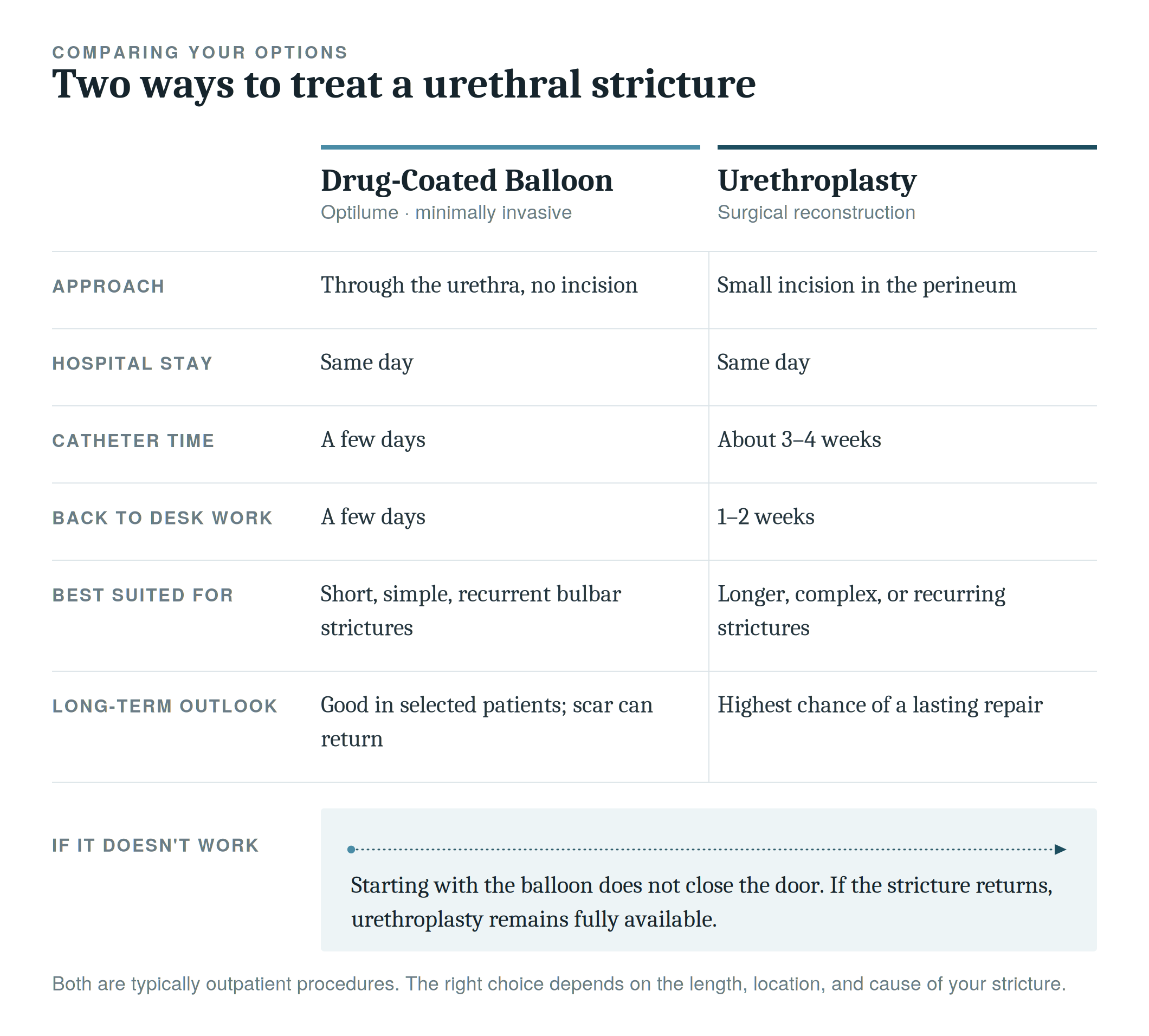
Recovery: Outpatient, under anesthesia or sedation. A catheter usually stays in for a few days. Most men are back to normal activity quickly.
Option 2: Reconstructive surgery (urethroplasty)
Urethroplasty is a surgical repair of the urethra and is widely considered the gold standard for a durable, long-term result.
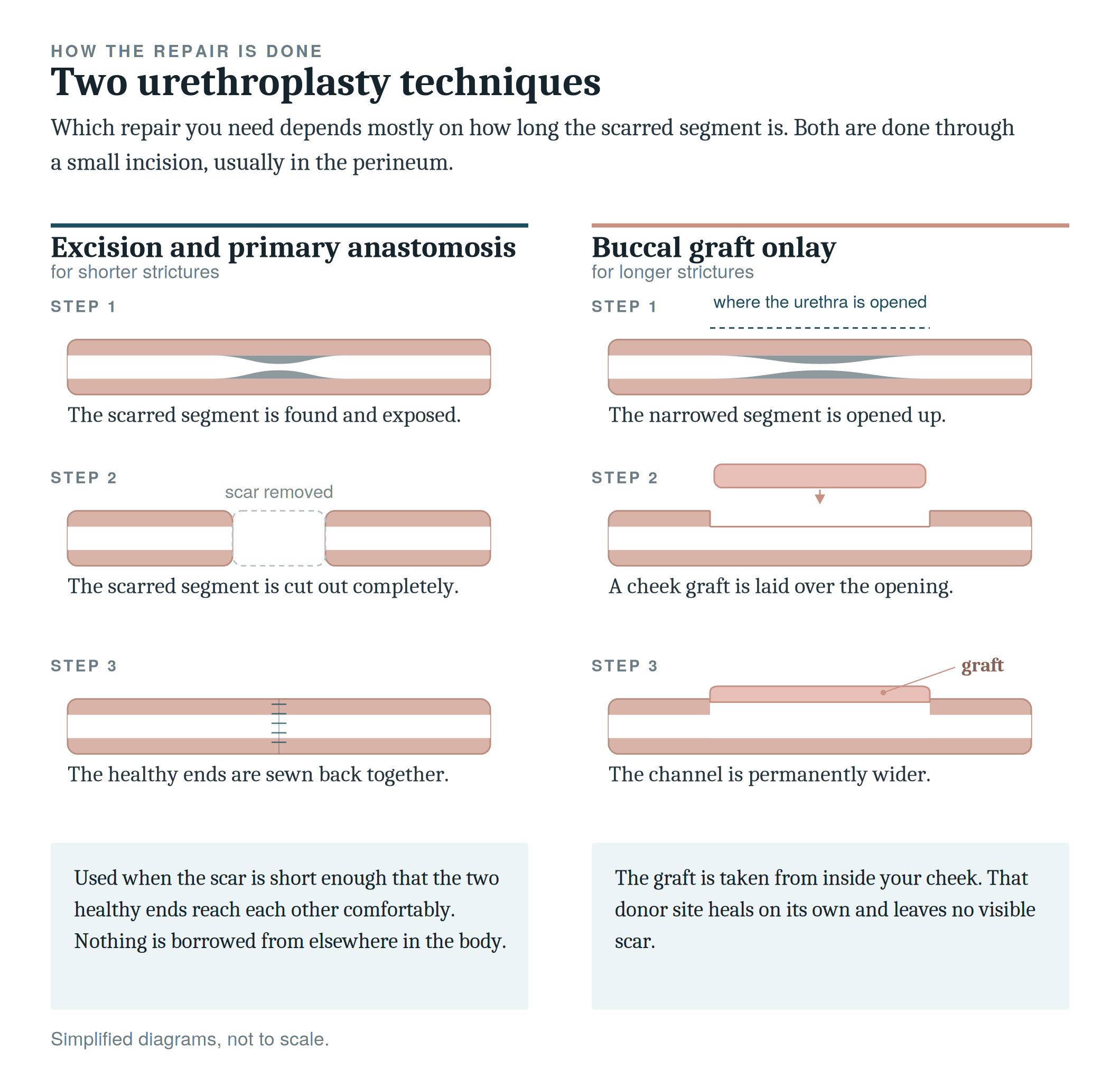
How it works: Through a small incision, usually in the perineum, the scarred segment is either removed or opened up, and the urethra is rebuilt into a wide, healthy channel.
For short strictures, the scarred segment is removed and the two healthy ends are sewn back together.
For longer strictures, the channel is widened using a graft. Most often this is a small piece of tissue taken from the inside of your cheek, called a buccal graft. Cheek tissue is ideal for this: it's thin, durable, already accustomed to a wet environment, and leaves no visible scar.
Success rate: Long-term success is generally in the range of 85% to 95%, depending on the location, length, and cause of your stricture. It is highest for short bulbar strictures and lower for radiation-related or very long strictures.
Who tends to do well: Men with longer or more complex strictures, men whose strictures keep coming back, men with lichen sclerosus or prior hypospadias surgery, and anyone who wants the most durable answer available.
Recovery: Usually same-day surgery. A catheter stays in for about 3 to 4 weeks. Before it comes out, we do a quick X-ray to confirm the repair has healed. Most men with desk jobs return to work in one to two weeks, and we ask you to avoid strenuous activity, cycling, and sexual activity for roughly six weeks.
Comparing treatment options
Making the right choice
There is no single best answer. The right choice depends on the specific anatomy of your stricture, what treatments you've already had, your other medical conditions, and what matters most to you — a faster recovery, or the most durable repair.
Our job is to lay out both paths honestly, including where each one is likely to fall short for you, and then help you choose.
Questions worth asking at your consultation
Am I a candidate for both options, or just one?
Given my specific anatomy, what success rate would you expect for me?
What exactly would recovery look like, and how long would I have a catheter?
What are the risks that matter most in my case?
If we start with the balloon and the stricture returns, what's the backup plan?
How will we know if it's working, and how often will I need follow-up?
To schedule a consultation and discuss which option is right for you, please visit our CONTACT page.